

Senile Endothelial Degeneration

Why Should I Bring my Pet to Willows for Senile Endothelial Degeneration?
Willows is one of Europe’s leading small animal referral centres. Our state-of-the-art hospital is led by internationally renowned Specialists, committed to providing the highest standards of veterinary care. Our Specialist Ophthalmologists are supported by our multi-disciplinary team of Specialists across a number of different disciplines including; Anaesthesia, Diagnostic Imaging and Emergency and Critical Care.
Willows also has a large dedicated team of Vets, Nurses and clinical support staff available 24 hours a day, every day of the year to provide the best possible care for your pet.

What is Senile Endothelial Degeneration (Cornea Oedema)?
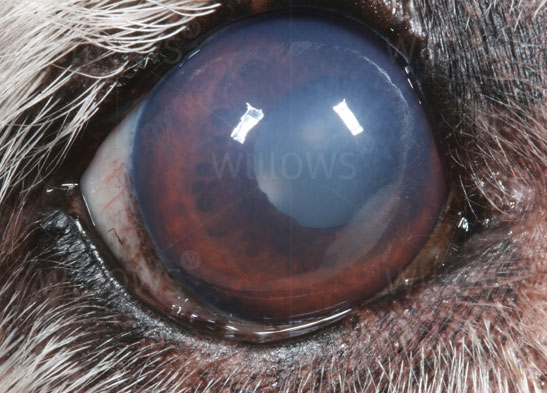
Senile endothelial degeneration is a corneal condition that occurs in older dogs. The normally clear cornea (the clear front surface of the eye) becomes water-logged and swollen, this is called corneal oedema. It makes the surface of the eye look blue or cloudy, similar to a steamed-up window. The blueness is often mistaken for cataract which is very different – a cataract is when the lens deep inside the eye goes cloudy.
Fig 1: Mild corneal oedema in a Golden Retriever, making the cornea appear ‘steamy’
What is the cause of Senile Endothelial Degeneration?
The cornea is the clear transparent window at the front of the eye. In order to be transparent, the inner lining of the cornea (endothelium) has thousands of tiny ‘pumps’ that keep water out. With age the number of pumps naturally decreases. In most dogs, the eyes compensate and no problems occur. However, in some dogs, the number of pumps falls to a critical level and so corneal oedema develops.
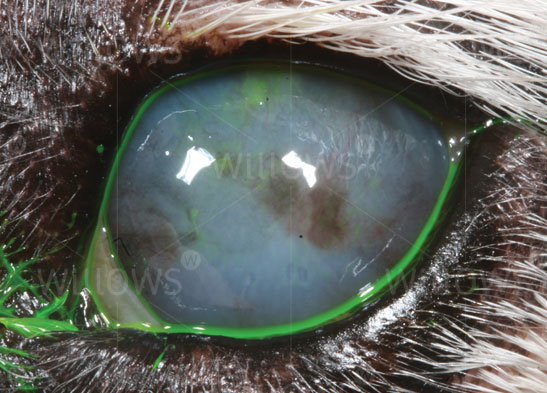
Fig 2: Advanced degeneration of the cornea. Ulcers have developed (stained green using a special dye) causing blood vessels and brown pigment to invade the cornea.
What are the Signs of Senile Endothelial Degeneration?
In the early stages, corneal oedema causes visual impairment as the clear window at the front of the eye is cloudy or ‘steamed up’, there is no pain at this stage. With time, the water-logged cornea becomes over saturated, and small ‘blisters’ form on the surface. These blisters burst spontaneously from time to time and cause small ulcers. These ulcers cause pain, which in turn causes symptoms such as blinking, squinting, weeping and light-shyness.
How is Senile Endothelial Degeneration Diagnosed?
This condition is diagnosed with a full ophthalmic examination by our Ophthalmology Specialist team, including slit lamp biomicroscopy, indirect ophthalmoscopy, ocular tonometry, and a diagnostic contrast agent for staining of the cornea.
How is Senile Endothelial Degeneration Treated?
There is currently no treatment that can restore the damaged endothelial cells, so management focuses on controlling discomfort and protecting the corneal surface. Treatment is tailored to each individual patient depending on the severity of the condition.
Conservative medical treatment:
For mild to moderate cases, medical management with lubricating eye drops or ointments can help to reduce surface dryness and discomfort, and topical salt (hypertonic) solutions may temporarily draw fluid out of the cornea and reduce swelling. However, in more advanced cases — particularly where painful surface ulcers are developing — surgery is recommended.
Surgery:
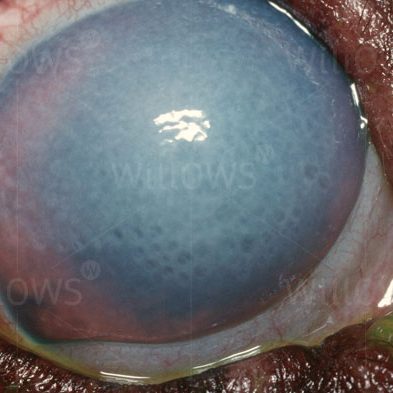
Thermokeratoplasty involves applying a fine, heated probe to the surface of the cornea in a grid pattern. The aim of this surgery is to bring an end to eye pain rather than improve vision.
Thermokeratoplasty does not reduce the cloudiness of the eye, and in some cases it can make it slightly worse, as such surgery is usually only recommended in advanced cases where the cornea is already very cloudy and recurrent ulcers are causing pain.
The letter-box technique (modified keratoleptynsis) is an alternative surgical procedure that may be considered in cases where the corneal swelling is more advanced or where thermokeratoplasty alone is unlikely to be sufficient. The technique involves performing a superficial keratectomy — carefully removing a thin layer of the outermost corneal tissue — in two strips above and below the central visual axis (hence the name 'letter-box'), followed by placement of thin tissue flaps from the conjunctiva (the pink tissue surrounding the eye) over these areas. This brings a new blood supply to the affected regions and helps to reduce corneal swelling, while preserving a clear central window for vision. Importantly, the procedure is designed to maintain as much central corneal clarity as possible.
Your specialist will advise which surgical approach is most appropriate for your dog at the time of your consultation.
At the end of the procedure, the surgeon will usually place a contact lens on the surface of the eye to help the healing process and make the eye more comfortable. Following the surgery, the operated eye is usually comfortable, but if the contact lens falls out early on, some dogs will only partially open the eye for a few days.

Fig 3: An eye undergoing Thermokeratoplasty under general anaesthesia.
What can I Expect if my Pet is Treated for Senile Endothelial Degeneration?
Following surgery, your dog may need to wear a collar to prevent damage to the eye(s) that may be caused by rubbing or scratching. Gentle cleaning of the eye with wet cotton wool twice a day is recommended. An antibiotic drop or a topical lubrication is generally applied to the eye for seven to ten days following surgery. A short course of painkillers may also be prescribed.
Thermokeratoplasty is a very successful surgery in uncomplicated cases, and the operation is commonly carried performed by the Specialist Ophthalmology team at Willows. Surgery aims to bring eye pain to an end rather than improving vision.
Fig 4: An eye which has healed following thermokeratoplasty.
To save this page as a PDF, click the button and make sure “Save as PDF” is selected.
Ophthalmology
Find out more
To assist owners in understanding more about Ophthalmology we have put together a range of information sheets to talk you through the some of the more common conditions seen and treated by our Specialists.