

Treatment of Corneal Ulcers

Why Should I Bring my Pet to Willows for Treatment of Corneal Ulcers?
Willows is one of Europe’s leading small animal referral centres. Our state-of-the-art hospital is led by internationally renowned Specialists, committed to providing the highest standards of veterinary care. Our Ophthalmologists are supported by our multi-disciplinary team of Specialists across a number of disciplines including; Anaesthesia, Diagnostic Imaging and Emergency and Critical Care.
Our Surgeons are supported by a highly trained and caring team of Veterinary Nurses including a dedicated Ophthalmic Nurses, all of whom play a vital role in the recovery and management of patients 24 hours a day, every day of the year. Willows is committed to staying at the forefront of veterinary ophthalmology, investing in the latest technology and techniques to ensure every patient has access to the best possible care.
What is a Corneal Ulcer?
The cornea is the clear 'window' at the front of the eye. It is a delicate structure, less than a millimetre thick, consisting of an outer layer of skin (the epithelium), a thicker middle layer (the stroma), and a thin inner lining (the endothelium). A corneal ulcer occurs when the outer skin of the cornea is damaged or lost, leaving the layers beneath exposed.
Corneal ulcers range considerably in severity. Most simple, superficial ulcers heal within five to seven days with appropriate medical treatment and carry an excellent prognosis. However, some ulcers become complicated — either because they fail to heal as expected, or because infection sets in and triggers progressive breakdown of the deeper layers. These complicated ulcers require prompt specialist attention, as without treatment they can threaten both vision and the eye itself.

What are the Most Common Causes of Corneal Ulcers?
Corneal ulcers can arise from a variety of causes including trauma, foreign bodies, infections, abnormalities of the eyelids or eyelashes, reduced tear production (dry eye), and reduced corneal sensation. Certain breeds with short, flat faces — such as Pugs, French Bulldogs and English Bulldogs — are particularly prone to corneal ulcers because their prominent eyes are more exposed and their blink reflex may be less effective. Complicated or infected ulcers can also occur secondary to underlying problems that compromise the cornea's ability to heal normally.
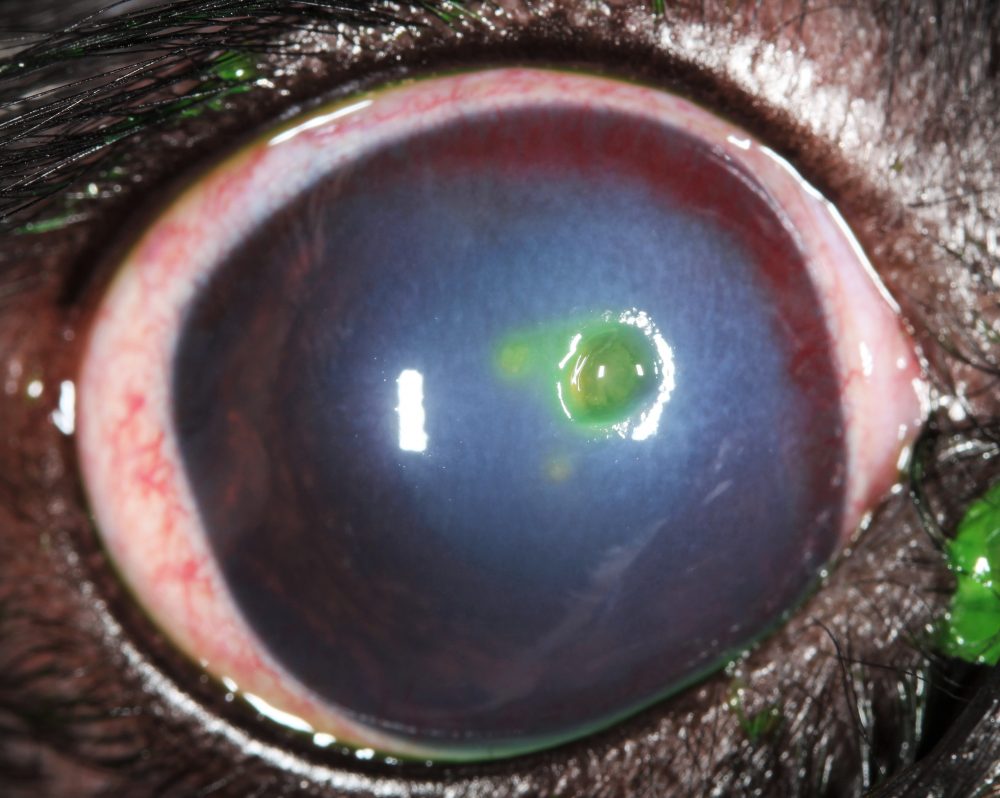
Fig 2: Stromal corneal ulcer
What are the Signs of a Corneal Ulcer?
Pets with a corneal ulcer are typically uncomfortable and may show one or more of the following signs: squinting or holding the eye closed, excessive tearing or discharge, redness of the white of the eye, a cloudy or bluish appearance to the cornea, pawing at the eye, or being quieter and less active than usual. If you notice any of these signs, your pet should be seen by a vet promptly, as corneal ulcers — particularly infected ones — can deteriorate rapidly.
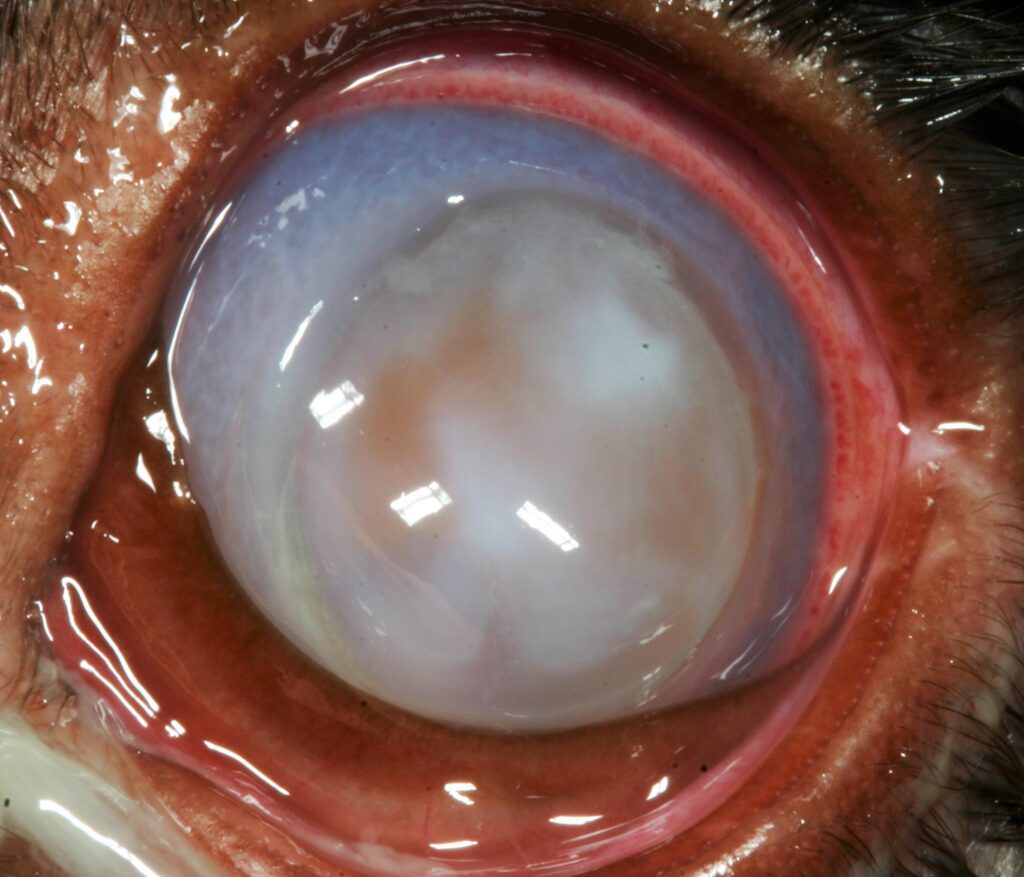
Fig 3: Infectious melting corneal ulcer
How is a Corneal Ulcer Diagnosed?
Diagnosis is made by applying a harmless fluorescent green dye (fluorescein) to the surface of the eye. The dye highlights areas where the outer surface of the cornea is absent, allowing the ulcer to be identified under a blue light. A full ophthalmic examination will also assess the depth of the ulcer, whether there are signs of infection or underlying disease, and what further investigations or treatment may be required.
What Treatments are Available?
The appropriate treatment for a corneal ulcer depends on its type, depth and severity, and will be tailored to each patient by our Specialist team. In broad terms:
Simple superficial ulcers are usually managed with topical antibiotic drops to prevent infection, together with pain relief. Most will heal within one to two weeks with this approach, and patients are monitored with regular rechecks to confirm progress.
Non-healing superficial ulcers (SCCEDs / indolent ulcers) require a minor procedure to remove the loose, non-adherent surface tissue and stimulate healing. This is covered in more detail in our separate information sheet on SCCEDs.
Deep or infected ulcers require more intensive management. Treatment may include frequent topical antibiotics, anti-collagenase drops to slow corneal 'melting', systemic anti-inflammatories and pain relief, and in some cases surgery.
In all cases, identifying and addressing any underlying cause — such as dry eye, eyelid abnormalities, or reduced corneal sensation — is an important part of management to reduce the risk of recurrence.
As part of our commitment to offering the most advanced care available, Willows has recently introduced the PhotonUVC Vet — an innovative non-contact device that uses ultraviolet C (UV-C) light to deactivate bacteria and other infectious organisms directly on the cornea. Treatment takes just five seconds and is well-tolerated in most patients. The device can be used across a wide range of corneal ulcer cases, and is particularly beneficial in infected or rapidly progressing ulcers where rapid control of infection is important. Willows is among the first practices in the UK to offer this technology, and our clinical results have been very encouraging.

What can I Expect if my Pet is Treated for a Corneal Ulcer?
For straightforward ulcers, most pets are managed as outpatients and recover well with medical treatment. For complicated or infected ulcers, admission for close monitoring may be required for one to two days, after which treatment continues at home with regular rechecks.
Once an ulcer has healed, there may be some residual clouding or scarring of the cornea. In many cases this fades gradually over weeks to months, and vision often returns to normal or near-normal. Your Specialist will discuss the expected outcome with you at the time of your appointment.
To save this page as a PDF, click the button and make sure “Save as PDF” is selected.
Ophthalmology
Find out more
To assist owners in understanding more about Ophthalmology we have put together a range of information sheets to talk you through the some of the more common conditions seen and treated by our Specialists.